
Is the future invisible?
Nokia - or rather the rump of its phone brand - launched a new device recently that caught my attention. It is a ‘dumb’ phone. One with none of the expected features of a modern device. No touchscreen, no powerful graphics processor, no apps. But it does have one novel feature: an AI button.
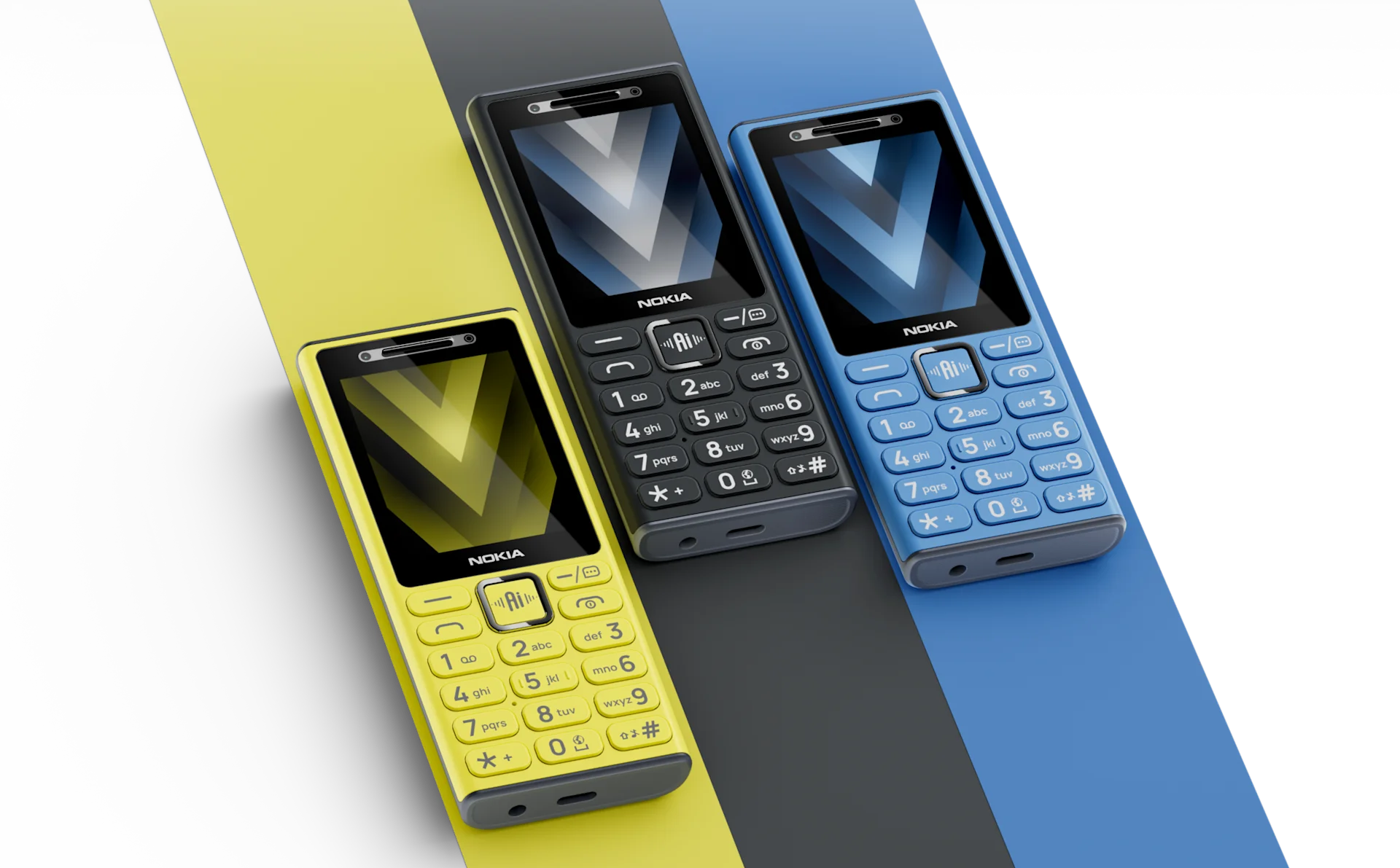
Old-school-style Nokia phones with a central AI button added
Sitting behind this button is a basic AI that helps you to do simple tasks on your device. But what if it was much more than that? What if, with just a very limited interface, you accessed an agent that did it all for you?
Human Machine Evolution
I’ve been talking to clients again recently about the evolutionary progression of our interface with machines. In short, every time we increase the available processing power by some significant amount, we tend to iterate the interface to make it more intuitive. More of the available processing power, when it becomes less scarce, is devoted to us being able to take advantage of the rest. This evolution has taken us from the punched card, to the typed command, the clicked icon, the swiped screen, and now the prompt - verbal or written.
I’ve long believed that the next natural iteration is towards mixed reality. Nothing, in my mind, could be more intuitive than digital artefacts that interact with us in the physical world. Smart glasses are a challenging proposition, with issues of privacy, comfort, disconnection from other humans, and personal style. But I always felt like the benefits they would bring - especially when combined with a personal AI - would overcome those challenges.
2D vs 3D
This new phone is the latest device that points to an alternative path. As babies we learn language at roughly the same time as we learn to move through the physical world. What if the next design paradigm is a private conversation with our invisible digital assistant, not an expansive invasion of the digital into the physical? An increasingly slight and analogue-feeling piece of personal tech that becomes two dimensional, near invisible in day to day life, with our hidden AI deep in the datacentre, paddling furiously, duck-like, to keep up with our whims and keep our lives on track?
Nokia’s device is far from the first to pursue this vision. Devices like Pocket, Plaud and Bee are increasingly spotted worn on people’s wrists or attached to the back of their phones, taking notes and helping them to capture and order their lives. Humane’s ambitious AI pin and Rabbit’s R1 have attempted to go further, reinventing the primary user device. But for some reason - perhaps the almost steampunk like juxtaposition of new tech and old - this one really grabbed me. Even though its actual capabilities are very limited.
Best of the worst?
Many people will, understandably, hate both of these future options for the human computer interface, and all their implications. The shrinking of our domain of responsibility, the increased prospect for the invasion of other people’s privacy and security (particularly women’s), the handing of huge amounts more power to tech giants, the reduced exercise of our minds and the increased implications for the planet.
I could argue with some of these criticisms. But I feel like I might be wasting my time: AI adoption is already well beyond the point at which we can debate whether or not we will or we should. If we feel that a technology is useful to us, we grab it with both hands. And while a lot of the population refuse or complain - often with very good justification - this particular genie is long out of its bottle. As long as it continues to grant wishes, there won’t be enough collective will to force it back behind the seal.
Whichever path we end up taking - and arguably there is no need for this to be a binary choice - our best hope is to regulate, manage, and control, whether through government, social pressure, or simple choice. To try to extract the best from the technology and manage its worst effects.
Making bets
Which way am I leaning? To some extent the future doesn’t need to be as homogenous as the present. Yes we all have slightly different phones and mixes of wearables, laptops, tablets etc. But the mobile device with its ~6in touchscreen, browser and apps has very much become the default human machine interface. Not everyone in the future will necessarily be quite so restricted to one form factor. Maybe some will prefer the AI experience without their visual field being cluttered with digital things. And some will prefer to live permanently in a re-written reality.
If I had to guess, I would say that perhaps the invisible AI is now likely to do more of the heavy lifting, with the mixed reality interface something that we switch in and out of. Many might still fulfil my prediction of living in it for ten hours a day. But there is now a clearer alternative.